- Home
- Residential
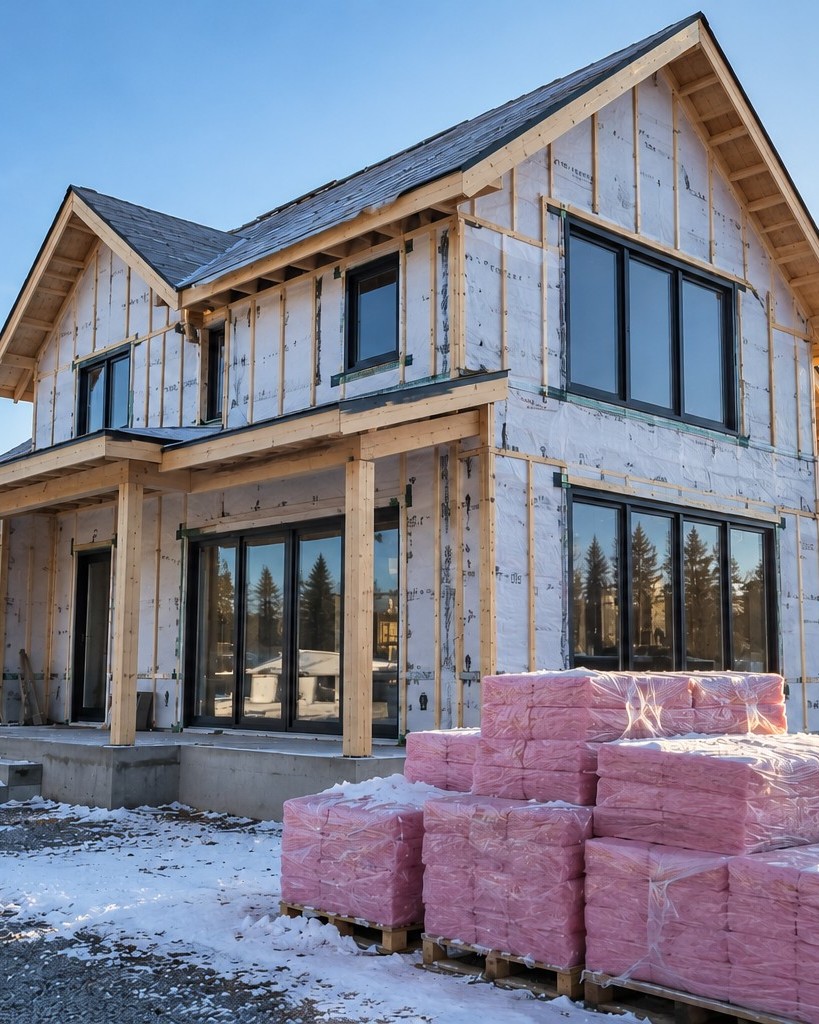
Your home, understood before it is changed
A cold room, drafts, high bills or a renovation project: we start by understanding your building, not by selling you a material.
Familiar situations, not an instant diagnosis
These situations are worth checking. On their own, they do not prove a lack of insulation.
Colder or warmer rooms
Possible causes: insulation, air tightness, ventilation or a combination of factors.
Noticeable drafts
May be related to air tightness, windows or other parts of the building envelope.
Energy bills that seem high
Several factors can play a role; an assessment helps pin down what can be verified.
Renovation or upgrade
A renovation, an addition, or a wish to rethink part of the building.
An assessment is used to understand the building’s conditions before recommending any work — never the other way around.
What we do, step by step
Building assessment
A review of the observed conditions before any recommendation.
Understanding your needs
Your situation, your goals and the constraints specific to your home.
Recommendation and planning
Proposed work based on the observed conditions, clearly explained.
Materials chosen for your building, not imposed in advance
Depending on the building, the area involved, the need and the observed conditions, our work may use, among others, Owens Corning PROPINK blown-in fibreglass, Igloo blown-in or dense-pack cellulose, Owens Corning batt insulation, mineral wool (rock wool), polyurethane foam, as well as vapour barriers, membranes and air-sealing products. These mentions do not make us a designated representative of these manufacturers: these materials are simply among the options we can use depending on the project. The material chosen for your situation is confirmed during the assessment, never before.
Materials suited to each part of the building
Blown fibreglass
Loose-fill fibreglass, including Owens Corning ProPink, is among the options for accessible attic areas. Installation depends on project conditions.
Blown or injected cellulose
Cellulose, including Igloo products, may be considered as loose fill or in cavities according to the assembly and manufacturer’s specifications.
Batt insulation
Insulation batts, including Owens Corning products, fit appropriate cavities. Correct fit and continuity matter alongside product selection.
Stone wool
This material family can be considered for insulation or soundproofing, depending on the wall assembly and project objective.
Polyurethane foam
Use depends on the area, substrate, application conditions and assembly requirements. It is not an automatic solution for every need.
Membranes and sealing products
Vapour barriers, membranes, tapes and sealants help address junctions and envelope continuity according to the detail being built.
Brand names identify material options, without implying designated representative status. Materials and applicable work are confirmed after assessment; they do not by themselves guarantee a result or grant eligibility.
Six services confirmed at launch
Each service is considered based on the conditions observed during the assessment — never recommended remotely, never guaranteed in advance.
Attic insulation
Relevant when the attic is poorly insulated, when some upstairs rooms are colder or when drafts can be felt. The current state of the insulation is assessed before any recommendation.
Request an AssessmentAir sealing
Relevant when drafts or air leaks can be felt around openings or foundations. Aims to improve air tightness in the areas identified during the assessment.
Request an AssessmentInsulation removal
Relevant when existing insulation is damaged or must be removed before a new project. Removal is considered based on the conditions observed on site, never diagnosed remotely.
Request an AssessmentAttic encapsulation
Encapsulation involves applying a coating to certain attic surfaces. It is not mould decontamination and does not replace correcting a moisture problem or any specialized work that may be required. Learn more
Request an AssessmentWall insulation
The right insulation material is determined by the wall assembly, the characteristics of the building and the needs of the project.
Request an AssessmentSoundproofing
Relevant when noise can be heard between rooms or from outside. The options considered depend on the source of the noise and the structure of the building.
Request an AssessmentPotential rebates for exterior wall insulation
Programs depend on your building’s province, regardless of your language. Check the requirements before planning the work.
Rénoclimat — up to $7,000
For exterior wall insulation in an eligible house, depending on area, performance and the new pathway’s criteria effective October 1, 2026. A pre-work energy assessment is optional but recommended. Work must be carried out by an appropriately licensed contractor; invoices and a signed compliance attestation are required.
Home Renovation Savings — up to $3,600
For exterior wall insulation through the energy assessment pathway. Arrange the initial assessment with an approved service organization before any work starts, then complete at least two qualifying upgrades and the final assessment. Home, heating and work requirements apply. The amount depends on area and added insulation.
Ontario: confirm deadlines before committing
The terms reviewed require the final assessment within 180 days of the initial assessment or by December 31, 2026, whichever comes first. Its booking must be entered in the program’s system by November 30, 2026. Confirm these dates and your project’s timeline with the service organization before work starts.
Already participating in Rénoclimat? Your file may follow the former rules, with a post-work assessment by March 31, 2027. Confirm your file’s rules with the program.
Isolation Maël Construction reviews the work and prepares an estimate; this does not replace a program energy assessment. Maël does not represent any program and guarantees neither eligibility nor payment. Check combination rules before relying on multiple rebates for the same work.
Official sources checked October 27, 2026. The terms in effect for your application apply.
Attic encapsulation: a service with clearly explained limits
Encapsulation involves applying a coating to certain attic surfaces. It is not mould decontamination and does not replace correcting a moisture problem or any specialized work that may be required.
This work is not always necessary. Some clients nonetheless want it to improve the appearance of surfaces or to feel more comfortable with how they look, particularly during a real estate transaction. In such cases, its effect may be mainly cosmetic; on its own, it does not demonstrate the absence of contamination.
Our experience in building assessment and mould investigation leads us to explain precisely what each type of work can accomplish. We offer encapsulation when it meets a clearly defined need, specifying its limits and distinguishing its effect on the appearance of surfaces from genuine decontamination.
Our advice is based on a technical understanding of moisture and contamination problems, with the Quebec standard BNQ 3009-600 as the reference for building investigation and rehabilitation. Our responsibility is to help you understand the proposed work, without attributing to the coating results that it cannot, on its own, demonstrate. When decontamination is required, we refer you to specialized resources.
Before agreeing to “decontamination by encapsulation”
If work is presented to you as decontamination by encapsulation, ask what it actually includes: investigation of the situation, identification and correction of the causes of moisture, cleaning or removal of materials where necessary, and verification of the results.
Applying a coating alone is not enough to demonstrate that decontamination has been carried out. A clear quote should distinguish the work performed, its limits and the expected results. This is the transparency we prioritize with our clients.
What an assessment can check
A symptom can have several causes. The assessment exists to separate what can be observed from what still needs to be confirmed.
- The current conditions of the building, based on what is observed on site.
- The possible cause or causes behind a reported situation.
- Whether any work may be relevant, and which option is worth considering.
How a residential project unfolds
Understand
We gather information about the building and the situation you have noticed.
Recommend
We explain the proposed work, its scope and its limits.
Plan
You know what will be done, when, and how your space will be protected.
Carry out and follow up
The work is done with care, with clear follow-up afterwards.
Factors that can affect the scope and the price
No made-up numbers: here are the general categories that typically affect a residential insulation quote.
| Factor | Why it matters |
|---|---|
| Size and accessibility of the area involved | Affects preparation and installation time. |
| Current condition of the building | Additional preparation may be needed depending on the observed conditions. |
| Exact scope of the project | A targeted area is different from more extensive work. |
| Access and protection of the premises | Some access points require more precautions or more time. |
The exact price and the applicable materials are determined case by case, after the assessment.
Types of buildings considered
- Single-family homes
- Owner-occupied duplexes and triplexes
- Owner-occupied multi-unit buildings
- Owner-occupied condominiums
- Owner-occupied new construction
- Existing buildings
Project eligibility is confirmed based on the building, the scope of work, access conditions and the observed needs.
What homeowners often ask
In many cases, a building assessment is needed before recommending specific work. We will tell you the best way to proceed for your situation.
No. The recommendation depends on the observed conditions, not on an automatic response to a symptom.
Our priority service area runs from Luskville to Masson-Angers, and from Nepean to Orléans in Ottawa. Requests in other areas are considered according to the project. Check your area to learn more.
A project involving asbestos is not automatically ruled out. Report any known or suspected asbestos before the assessment. Appropriate checks, any required specialist arrangements and each party’s responsibilities must be clarified before the affected work.
No. Isolation Mael Construction does not do mould decontamination. When decontamination is required, we can refer you to appropriate resources.
Let’s talk about your building
Describe your situation; we will help you figure out the most useful next step.
Prefer to call? 873-636-0183